Cancellations and changes leave money on the table in the form of unused ticket value. Most corporate programs don’t know where those credits are, whose name they’re under, or when they expire. Travel Code just shipped the wallet that fixes that.
The problem: airline credits expire, and most programs miss them
When a business trip cancels or changes, the airline rarely refunds cash. What you get instead is an unused ticket value locked to the traveler, valid for a limited window — typically 12 months from the original purchase date, sometimes shorter, occasionally per-fare-family with its own rules. Points don’t expire the same way; credits do.
In every corporate program we’ve looked at, the pattern is the same: credits accumulate in the airline’s system, nobody actively tracks the expiry, and by the time a fresh booking is being made, the credit is either forgotten or already gone. On $5M in annual spend, the leakage typically runs into five figures a year.
What we just shipped: the airline-credits wallet
Inside every Travel Code corporate account, the program can now register the airline credits it’s holding — per airline, per traveler, with the ticket number and expiry date. The wallet becomes the single place the whole company sees the position from.
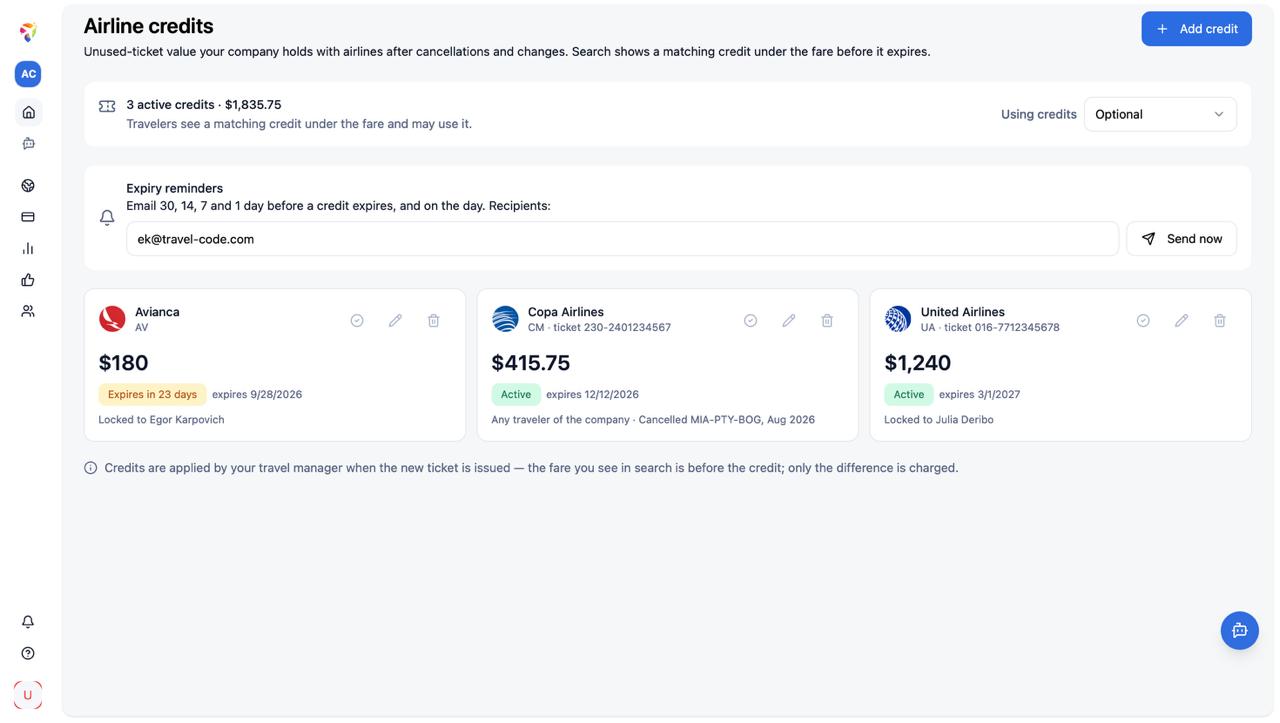
Each credit shows: the amount, the airline, the ticket number, the expiry date, and who it’s locked to (a specific traveler for most fare rules, or “any traveler of the company” where the airline permits reassignment). In the example above, the company is sitting on $1,835.75 across Avianca ($180, expires in 23 days), Copa ($415.75), and United ($1,240).
Credits are surfaced at the moment of booking
The wallet is only useful if the credit appears in front of the traveler when they are actually shopping. In Travel Code, a company with active credits sees them at the top of the search page — with a “Search first” shortcut that pre-filters to the routes and fares the credit could plausibly apply to.
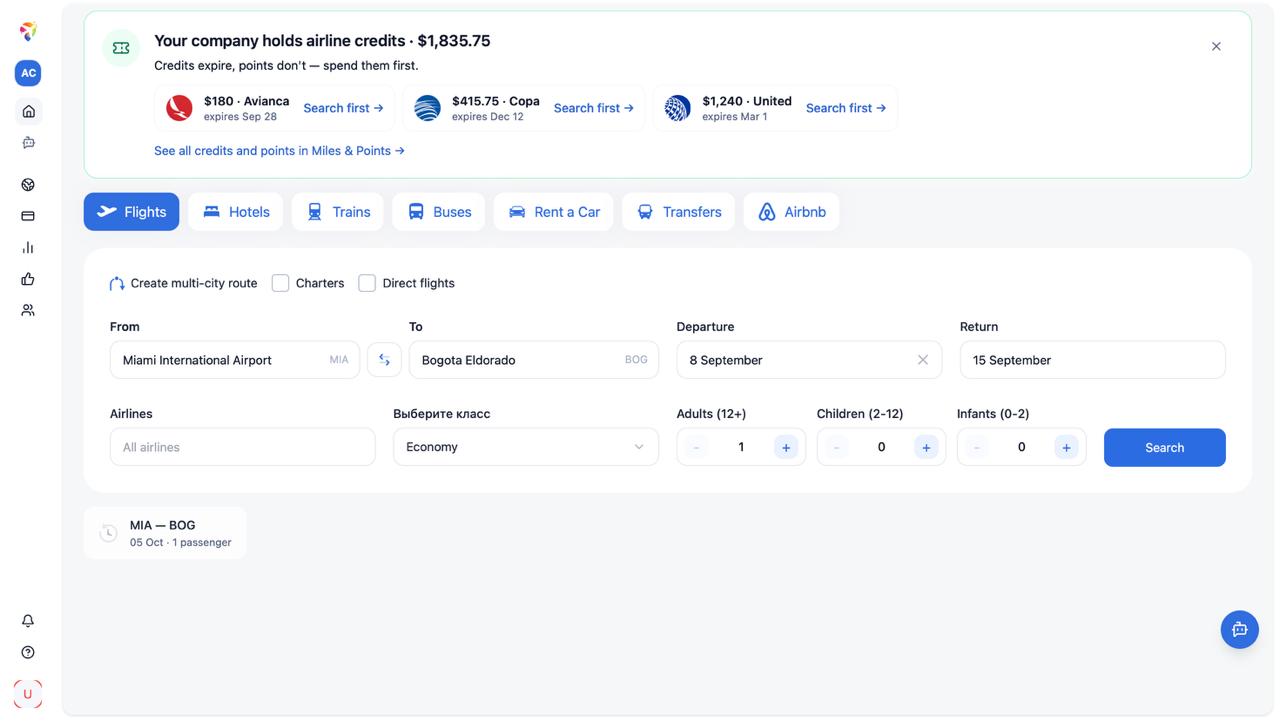
When the traveler runs a search on an airline where the company has a credit, the matching fare is flagged and the credit is applied automatically at issue — the traveler sees the full fare in results, and only the residual difference is charged to the corporate card.
Expiry reminders that actually get read
Each credit has its own countdown. The system sends an email to the addresses the program specifies at 30, 14, 7, and 1 day before expiry, and again on the expiry day itself. Reminders are staged so the earliest touchpoints go to the travel manager and the last ones to the traveler themselves — no more “we forgot about it” excuses from either side.
Current state: manual entry; Amadeus and Sabre integration coming
Today the credits are added manually — the travel manager pastes the amount, airline, ticket number, and expiry, and we do the rest (matching, display, reminders). This is the first shipped version and it is fully functional for programs whose credits live in a few known airlines.
The next release plugs the wallet directly into Amadeus and Sabre, so credits from cancellations get pulled into the wallet automatically on the day they’re issued — no manual step. For programs whose credit volume runs into the dozens per month, that removes the last friction.
Why this is a cost lever in 2026, not just a nice-to-have
Two things have shifted in corporate travel this year. First, cancellation rates on business trips are elevated across the board — companies are more willing to hold trips on ambiguous itineraries and cancel late, which means more credits generated per unit of spend. Second, airline credit rules have gotten slightly stricter on transfers between travelers, meaning credits that used to be poolable now stay locked to a single name and expire unused when that person doesn’t fly again.
For a mid-market program, the annual leakage of expired credits typically exceeds what the same program spends on travel-management tooling in the same year. Recovering even half of it pays for the platform.
Free pilot for US corporate travel programs
The wallet is live inside every Travel Code corporate account today. We’re quietly onboarding a small group of US programs to use it against their existing credit balances at no extra cost — the first cohort gives us the operational patterns we need to ship Amadeus and Sabre integration cleanly.
If you run a US-based corporate travel program and you have unused airline credits scattered across two or more carriers that never make it into your booking flow, get in touch. We’ll spin up the wallet on your account and show you what would have been recoverable on your last quarter of activity.
The question worth asking
How much of what your program cancelled last quarter is still sitting as credit at the airline, and how many days do those credits have left before they’re gone?


